I’ll be honest.
The first time I heard about Wae Rebo traditional village, I thought it sounded like one of those “hidden paradise” phrases that travel blogs throw around too easily. You know the type. Remote. Authentic. Untouched. Insert dramatic sunset photo.
But Wae Rebo traditional village isn’t dramatic in that loud, social-media way. It’s quieter than that. And maybe that’s exactly why it stays with people.
You don’t just arrive at Wae Rebo traditional village. You work your way into it.
Most journeys begin in Labuan Bajo. Bright mornings at the harbor. Boats lined up. Guides chatting. Travelers coming back from sailing Labuan Bajo with salt in their hair and that slightly sunburned glow. The ocean feels endless out there. Wide. Open. Loud in color.
Then you drive inland.
The road narrows. The air changes. It’s subtle at first. Less salt, more earth.
And eventually, the car stops in Denge. Because that’s as far as wheels can take you.
The Walk That Makes You Question Your Choices (Just a Little)
From Denge, it’s a hike. Two to three hours, depending on your pace — and how often you pretend you’re “just enjoying the view” when you actually need a break.
The trail isn’t extreme, but it demands attention. Uneven ground. Tree roots. Occasional mud patches that look harmless and then… aren’t.
At some point, conversation usually fades. People focus on breathing. On footsteps. On the quiet hum of insects in the forest.
I remember noticing how the forest didn’t feel staged. No signboards every five meters. No background music (obviously). Just real forest sounds — the kind you forget exist when you live in a city.
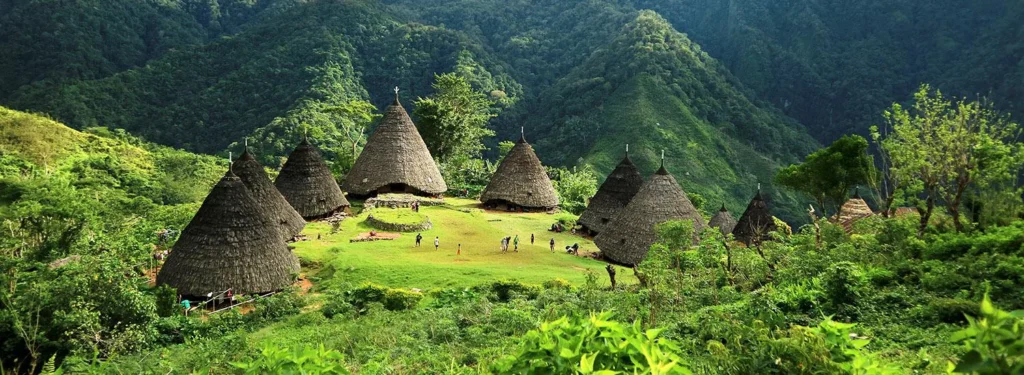
About fifteen minutes before reaching Wae Rebo traditional village, the air becomes noticeably cooler. Lighter. You step out of dense trees, and suddenly the clearing opens.
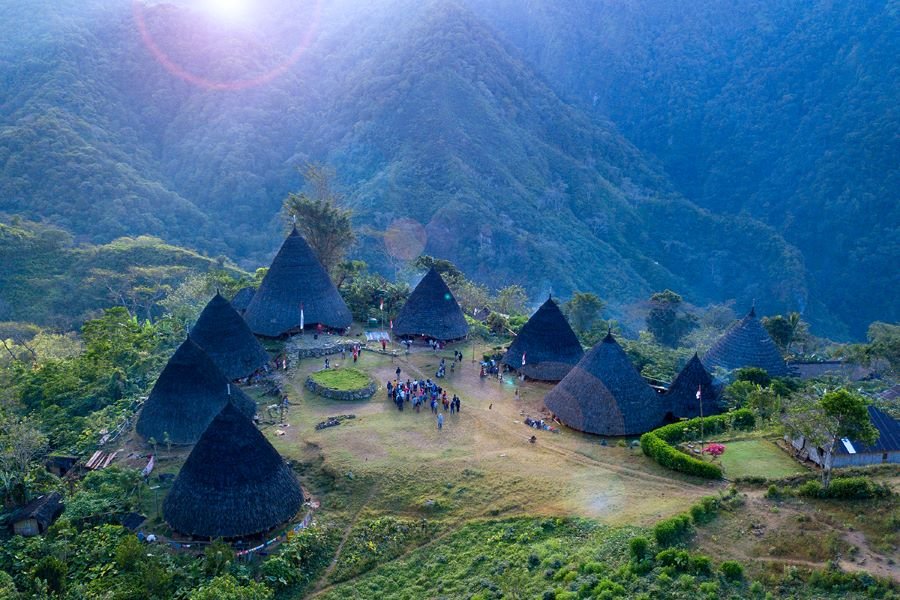
Seven tall, cone-shaped houses stand in a circular formation.
No dramatic entrance gate. No flashy welcome sign.
Just space.
And somehow, that simplicity feels deliberate.
The Mbaru Niang Houses: Simple, but Not Simple
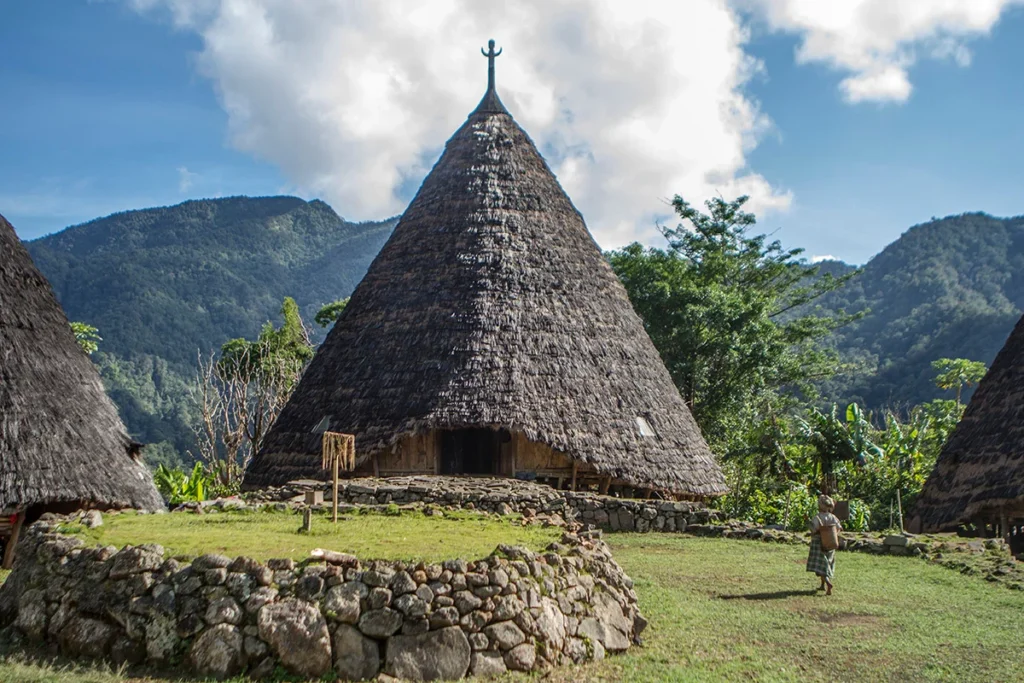
The iconic houses in Wae Rebo traditional village are called Mbaru Niang. From a distance, they look almost like giant woven hats placed upside down on the earth. Up close, they feel solid. Grounded.
Built from wood, bamboo, and palm fiber, each house rises several meters high and contains multiple levels inside — five, to be exact. The lower levels are for daily life. Cooking. Sleeping. Talking. The upper levels are used for storage and sacred purposes.
It’s architecture with meaning, not just design.
When you step inside one, your eyes take a second to adjust. The light is dim, filtered through thatched walls. Smoke from the central hearth floats upward slowly, softening everything. There’s a faint scent of wood and dried crops.
You notice small things.
The way the floor slightly shifts under weight.
The quiet murmur of someone speaking near the wall.
The warmth from the fire reaching your knees first.
It doesn’t feel like a museum.
It feels lived in.
A Village Above the Clouds — Literally
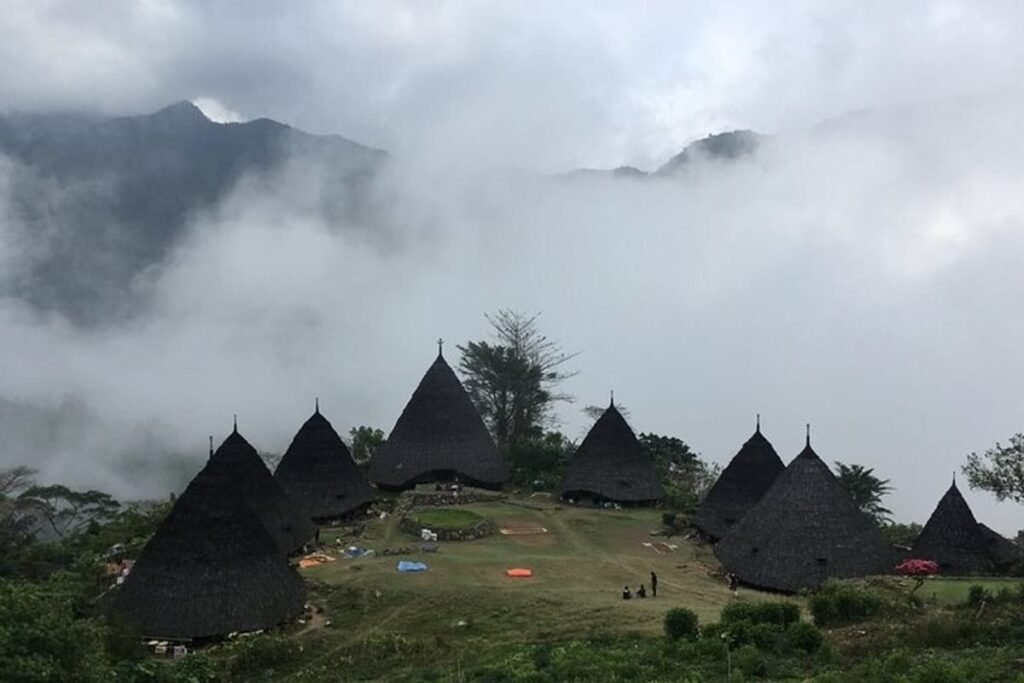
People call Wae Rebo traditional village a village above the clouds, and it sounds poetic until you wake up early enough to see it yourself.
At dawn, mist wraps around the houses so thickly that the edges blur. For a few moments, visibility shrinks. You step outside and the world feels smaller — softer.
Then slowly, almost shyly, the clouds begin to drift downward.
And there you are. Standing above them.
No exaggeration. No filter needed.
The surrounding hills rise and fall like green waves. When sunlight finally breaks through, it hits the thatched roofs in uneven patches. Not cinematic-perfect. Just real.
You don’t rush that kind of morning. You just stand there longer than you planned.
Recognized, But Not Commercialized
In 2012, Wae Rebo traditional village received recognition connected to UNESCO cultural heritage for its conservation efforts. The community had rebuilt several traditional houses using ancestral techniques after some had collapsed over time.
That detail matters.
They could have modernized. Concrete walls. Tin roofs. Faster construction. Instead, they chose to restore the Mbaru Niang the traditional way — even though it required more effort and cooperation.
The UNESCO cultural heritage acknowledgment brought attention, yes. More visitors. More awareness.
But it didn’t turn Wae Rebo traditional village into a theme park.
There are guidelines for visitors. A welcoming ritual upon arrival. A communal system where tourism contributions support the entire village. It feels structured — but not commercial in a loud way.
You’re a guest here. Not a consumer.
That difference is noticeable.
From Open Sea to Mountain Silence
Pairing sailing Labuan Bajo with a trip to Wae Rebo traditional village creates a contrast you don’t fully understand until you experience both.
On the boat, everything feels expansive. Wind in your face. Sun on your shoulders. Laughter echoing across water. You jump in and out of the sea without thinking twice.
In the mountains, movement slows.
You sit longer. Talk slower. Listen more.
One evening, I sat near the center stone altar in the middle of the village. The sky was unusually clear. Stars scattered across it — not faint ones, but sharp, unapologetic points of light.
Inside one of the houses, someone laughed. Then quiet. Then another burst of laughter.
No engine noise.
No distant traffic.
Just wind brushing against thatched roofs.
It felt almost unfamiliar.
Why Wae Rebo Traditional Village Feels Different
There are beautiful villages across Indonesia. Stunning viewpoints. Incredible architecture.
But Wae Rebo traditional village feels different because it doesn’t try too hard.
There’s no endless list of “top 10 things to do.” No aggressive souvenir stalls lining every path. Life continues here whether visitors arrive or not.
Children run across the clearing. Farmers discuss crops. Coffee beans dry under the sun in woven baskets. The daily rhythm isn’t rearranged for photos.
And maybe that’s the real draw.
You sense continuity.
The recognition tied to UNESCO cultural heritage ensures preservation, but the true preservation happens quietly — in everyday decisions to maintain circular housing patterns, to share income collectively, to pass down building techniques from one generation to the next.
It’s steady.
When you finally hike back down toward Denge, your legs feel it. The descent is easier physically, but you move slower than expected. Not because you’re tired. Because something about the pace up there lingers.
After days of sailing Labuan Bajo and standing on open decks surrounded by endless blue, Wae Rebo traditional village brings you inward. It narrows your focus. Grounds you.
It doesn’t overwhelm you with spectacle.
It doesn’t compete for attention.
It simply exists — high in the Flores mountains, occasionally wrapped in cloud, occasionally bathed in sunlight — consistent in a way that feels rare.
And long after you’ve left the village above the clouds, you might catch yourself remembering small details instead of grand views.
The smell of wood smoke in the morning.
The uneven texture of bamboo walls.
The quiet way the clouds rolled past without asking permission.
Wae Rebo traditional village doesn’t demand admiration.
It earns it slowly.
And somehow, that makes all the difference.